112 Guests, Zero Guilt: The Wedding-Planning Shortcut Couples Are Quietly Adopting
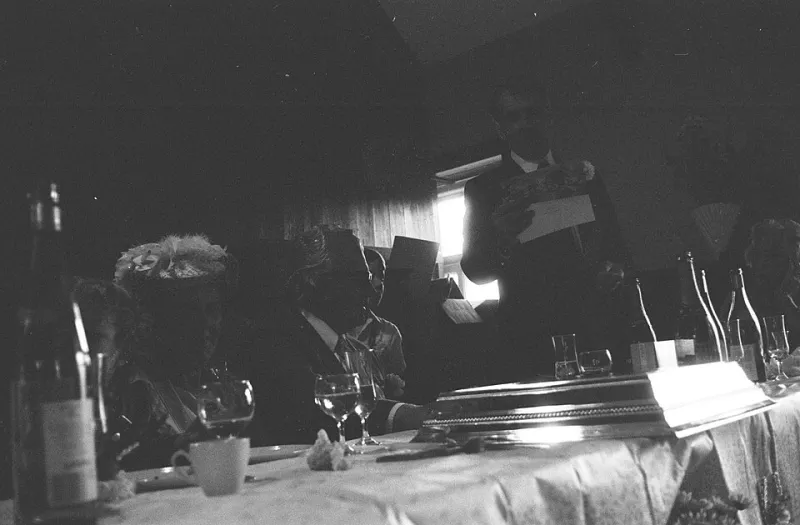
Photo: Geoff Charles, CC BY-SA 4.0, via Wikimedia Commons
Wedding planning has a way of turning a simple question — who do we invite? — into a group project with no grading rubric. There is the cousin you last saw at a graduation, the coworker who invited you to their backyard barbecue, the friend-of-a-parent who remembers your childhood birthday parties, and the plus-one question that can start a small diplomatic incident. So it makes a strange kind of sense that couples are latching onto a random number as a way out.
On TikTok, Reddit threads, and wedding-planning group chats, 112 guests has become a strangely satisfying cap. It is not a tradition. It is not a venue standard. It is not even a particularly round number. That is exactly why it works. When the guest list is a swirling cloud of obligation and affection, a specific number can feel like a decision someone else already made for you.
The appeal of a number that sounds official
Ask a couple why 112, and the answers are rarely poetic. It is close to 100 but feels less austere. It is below 125, a common venue-package threshold. It sounds intentional, like the result of a thoughtful planning session rather than a panic spiral. And unlike 100, which can feel like a budget diet, or 150, which can feel like a small convention, 112 has a Goldilocks quality: not too intimate, not too unwieldy.
The real magic is that it gives people permission to stop negotiating. A couple can say, 'We are keeping it to 112,' and the conversation shifts from who deserves an invite to how the room will work. It is the wedding equivalent of a deadline: arbitrary, but useful.
The math is weirdly friendly
Here is the part that makes spreadsheet-minded couples sit up straighter: 112 divides neatly in several directions. Fourteen tables of eight. Sixteen tables of seven. Eight tables of fourteen, if you are feeling theatrical. That kind of flexibility matters when a seating chart has to account for family clusters, friend groups, kids, plus-ones, and the one uncle who cannot sit near the DJ.
Venue math is friendlier, too. Many reception packages are built around headcount tiers — up to 100, up to 125, up to 150 — and 112 sits comfortably under a common 125-guest ceiling. Depending on the market and the menu, catering and rentals can climb quickly once a guest count crosses a threshold. A cap of 112 can keep a couple in a lower tier without forcing them into a 90-person room that feels half-empty.
It also gives the room a certain density. A 112-person wedding is big enough to fill a dance floor, small enough that the couple has a fighting chance of saying hello to every guest, and structured enough that the seating chart does not become a three-week hostage situation.
Venue psychology, with a side of vibes
Wedding planners have long talked about room 'feel.' A space that is too large for the crowd can feel echoey and awkward. A space that is too tight can turn dinner into a contact sport. A mid-size count like 112 often lands in the zone where a reception hall feels lively without feeling like a fire drill.
There is also the vendor reality. More guests mean more chairs, more plates, more place settings, more favors, more invitations, and more tiny decisions that add up. A cap of 112 does not make a wedding cheap, but it makes the budget more legible. Couples can see the shape of the thing.
A superstition with a spreadsheet
In the United States, 911 is the emergency number. In much of Europe, it is 112. That little coincidence gives the wedding cap a wink of internet mythology. Couples joke about hitting 113 and triggering an emergency, or about treating 112 like a guest-list commandment handed down from the algorithm. It is not a real superstition, but it functions like one: a small, memorable rule that cuts through decision fatigue.
That is the same energy behind other little rules people adopt online — five items in a capsule wardrobe, ten minutes of tidying, two minutes of someone else's day. A random number becomes a container for a feeling. In this case, the feeling is: we want a celebration, not a logistics convention.
Where the 112 ceiling gets tricky
No number can solve family politics. If a parent is contributing money, they may have opinions about the list. If a couple has large families, 112 might already be full before friends get a seat. And there is a real risk of using the number as a shield instead of a starting point. A guest cap should not become a reason to exclude someone who genuinely matters.
The healthiest version of the 112 wedding is not a doctrine. It is a draft. Couples can count the must-haves, the strong wants, and the maybes, then see how close they land. If the list naturally settles at 108, great. If it balloons to 140, the number was never the boss — it was just a useful boundary.
How to use 112 without making it weird
The practical move is simple: build the list in tiers. Start with the people who would be genuinely hurt to miss it. Add the people who make the party better. Then add the plus-ones and family obligations. If the total lands near 112, use that as the working number and let the seating chart breathe. If it does not, do not force it.
And maybe do not announce the number to every relative as if it were a federal regulation. 'We are aiming for about 112' sounds reasonable. 'We have a hard cap of 112 because TikTok said so' invites questions.
For couples in 2026, the appeal is easy to understand. Wedding planning is full of choices that feel enormous and personal, and sometimes a small, arbitrary rule is the only thing that keeps the guest list from becoming a referendum on every relationship you have ever had. The 112-person wedding is not magic. But if it helps two people save the date, protect their budget, and still invite enough people to fill a dance floor, that is close enough.
Here at KCT112, we will raise a glass to that — just not 113 of them.